
- Success Stories
- Environmental Resource Assessment & Management
Expanding Our Offshore Wind Team

We’ve recently added several staff to bolster the offshore wind team at NOAA’s National Centers for Coastal Ocean Science. With this full team of 13, our employee owners are able to provide more focused support in their areas of expertise, including mapping and spatial modeling, data collection, communications, project management, and partner engagement. Through this work, the team develops regional ecosystem-wide spatial models to inform siting of ocean use sectors, environmental review, and permitting, which provides guidance to the Bureau of Ocean Energy Management (BOEM) on suitable locations for offshore wind siting.
Sustainable coastal planning and development increases resiliency, creates jobs, reduces reliance on unsustainable imports, supports renewable energy, and grows the domestic Blue Economy. Check out the NCCOS Coastal & Marine Planning and Offshore Wind Energy spatial planning webpages to learn more.
This team is now providing spatial planning support in all U.S. ocean regions and was recently instrumental in BOEM designating two Wind Energy Areas in the Gulf of Mexico. As offshore wind continues to expand throughout U.S. waters, this team will continue to collaborate with BOEM to support the identification of suitable locations for renewable energy. Future work is slated for the U.S. Central Atlantic, Gulf of Maine, Oregon, and more to come!
See More CSS Insights

New Award with University of Pittsburg
CSS has recently acquired a new award working with the University of Pittsburg. As part of this work, a team of CSS employee owners has begun testing samples for Solidification Using a Baffle in Sealed Ampoules (SUBSA), a high temperature furnace with temperature and timing control for melting samples to create different materials and alloys.…
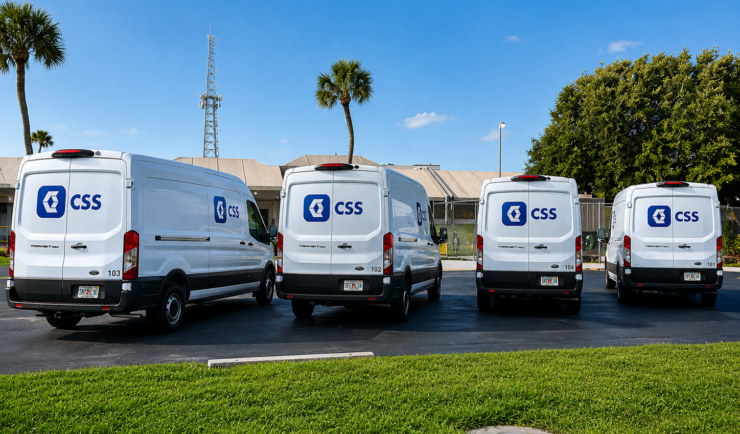
Supporting Florida’s Aerospace Facility
CSS recently launched our Florida Leased Facilities Team! Supporting the aerospace sector throughout Central Florida, these employee owners provide facility operations and maintenance coordination, HVAC, electrical, and general maintenance expertise. From preventive to reactive maintenance repairs, they help ensure each facility remains safe, functional, and ready for daily operations. Their professionalism, teamwork, and commitment to quality make a…
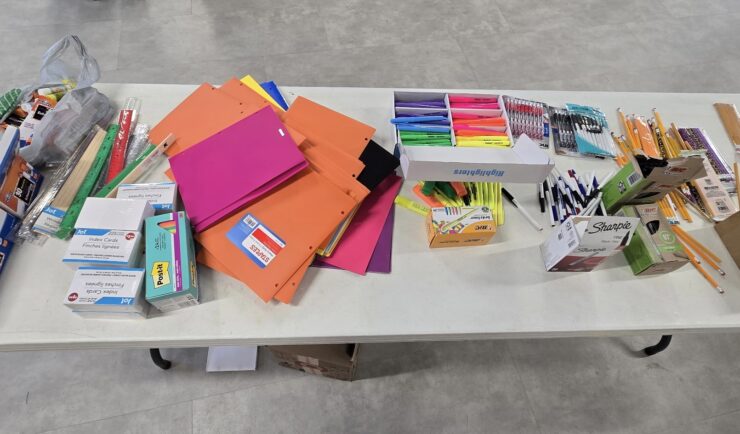
Hosting a Back-to-School Drive for Refugee Children in North Carolina
In August 2025, CSS hosted a back-to-school drive for child refugees in the North Carolina Triangle through CWS Durham, a non-profit specializing in refugee resettlement. With the help of many generous friends and family members, CSS successfully procured a backpack, lunchbox, water bottle, and clothes for 103 children, as well as stockpiles of 34 different essentials, covering school supplies, sanitary/hygiene items, food, and gift…